Every prompt here has earned its place in the catalog — tested, annotated, numbered, and set in
incantation-precise monospace. Break the seal on any plate to reveal the full text and copy it
in one click.
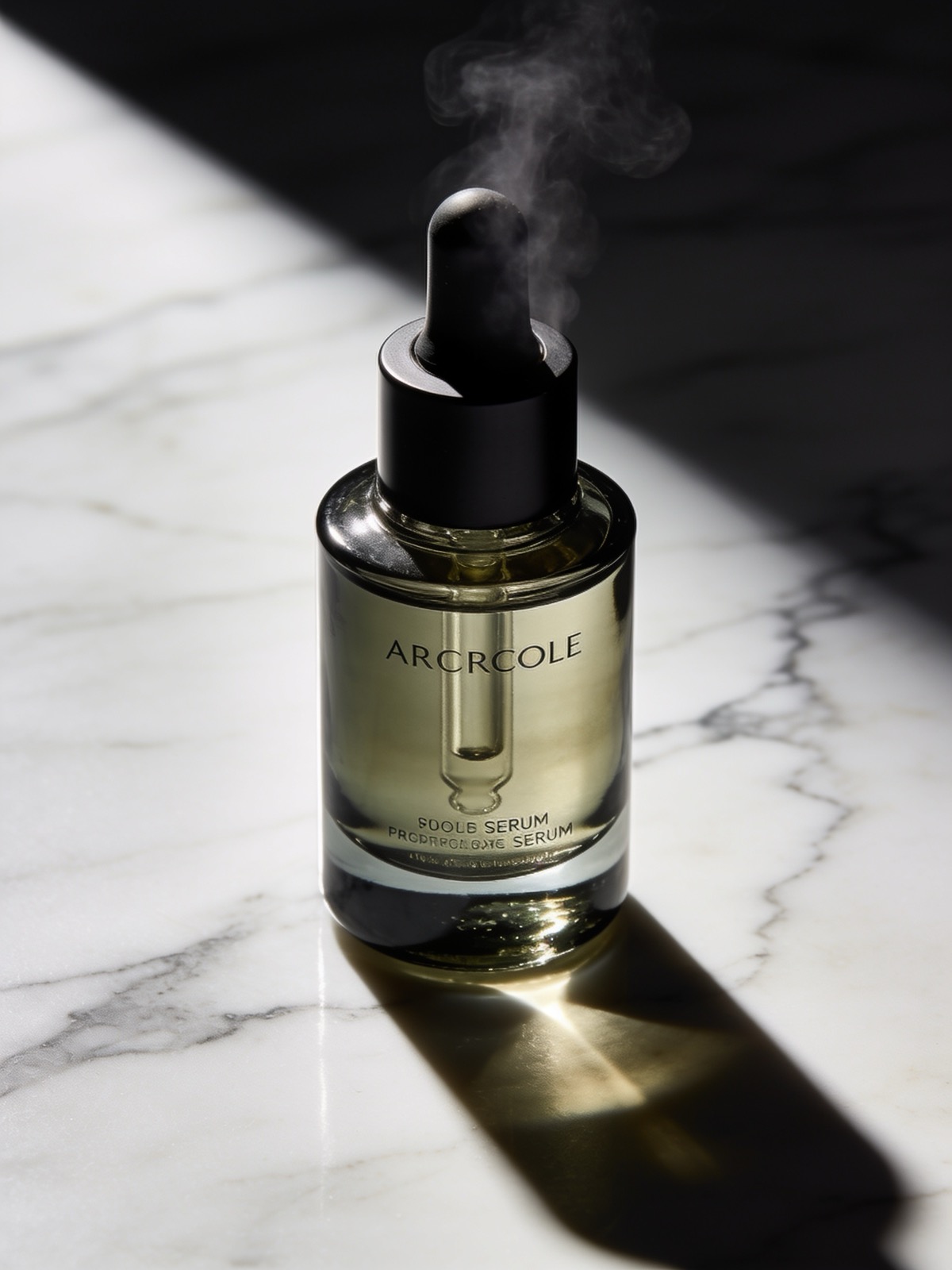
Luxury skincare serum bottle on a marble surface, single overhead key light with no fill, hard shadows, shallow depth of field, 85mm portrait prime lens f/1.8, minimal steam rising, dark charcoal background, hyperrealistic studio photography --ar 4:5 --style raw --s 30 --v 7
Close-up portrait of a woman in her 30s, rain-soaked Tokyo alley at 2am, neon red and teal reflections on wet pavement, Roger Deakins cinematography, anamorphic lens flare, 35mm film grain, melancholic expression, depth of field --ar 2:3 --style raw --s 50 --v 7
Bold sans-serif typographic poster, the phrase YOUR NAME IN LIGHTS rendered in holographic chrome foil, floating on deep navy background, prismatic light scatter, scattered holographic confetti, Y2K-meets-luxury aesthetic, centered composition --ar 9:16 --style raw --s 150 --v 7
You are a senior content strategist and expert writer. When I give you a topic, you will:
1. Write a detailed, opinionated 1,500-word blog post structured with an H1, 4-6 H2 sections, and a clear conclusion.
2. Open with a specific surprising stat or counterintuitive claim (not a question).
3. Use short paragraphs (max 3 sentences), plain American English, active voice.
4. Include one real-world example or mini case study per section.
5. Embed 2-3 natural internal linking opportunities marked as [LINK: anchor text → topic].
6. Close with a single, specific CTA.
Never use filler phrases like 'In today's fast-paced world' or 'It goes without saying'. Write with the confidence of someone who has done this work, not read about it.

Topic: [INSERT TOPIC]
Write a 4-email launch sequence for [PRODUCT NAME], a [brief description] for [target audience].

Email 1 (Day -3, Teaser): Build curiosity without revealing the product. End with an open loop. Subject line included.
Email 2 (Launch Day): Announce with a clear value proposition, price, and a single CTA button. Address the top objection in one line.
Email 3 (Day +2, Social Proof): Lead with a specific customer result or testimonial. Reinforce urgency if applicable.
Email 4 (Day +4, Final Call): Last-chance tone, restate the core transformation, close with scarcity or deadline.

Tone: conversational but authoritative, no hype language. Each email max 200 words. Include subject lines and preview text for all four.
Write a LinkedIn connection request message and a follow-up DM sequence (3 messages) for a [YOUR ROLE] reaching out to [TARGET ROLE] at [COMPANY TYPE].

Context: I offer [YOUR SERVICE/PRODUCT]. The prospect's likely pain point is [PAIN POINT].

Rules:
- Connection request: max 300 characters, no pitch
- Message 1 (after connection): lead with a specific observation about their company or content, then a soft question. Max 80 words.
- Message 2 (Day 5 follow-up): add value (share a relevant insight, stat, or short resource). Max 70 words.
- Message 3 (Day 10 breakup): respectful, no desperation, leaves the door open. Max 50 words.

No templates that sound like templates. Write like a real person.
Act as a senior competitive intelligence analyst. Create a battlecard for [YOUR COMPANY] vs [COMPETITOR].

Structure it as:
1. Their positioning in one sentence (how they describe themselves)
2. Their 3 strongest claims (with evidence if you know it)
3. 3 vulnerabilities or gaps in their offering
4. 5 objection-handling lines for when a prospect says 'we already use [COMPETITOR]'
5. The 2-3 deal-winning questions a salesperson should ask to expose the gap
6. Our strongest differentiator stated in under 15 words

Be specific and direct. No diplomatic hedging.
You are my chief of staff. I'm going to paste my task list, meeting schedule, and current goals for this week. Your job is to:
1. Identify the 3 highest-leverage actions that only I can do (not delegate)
2. Flag any tasks that are low-leverage and should be delegated or deleted
3. Identify any goal-to-task misalignment (things I'm doing that don't move any goal forward)
4. Rewrite my to-do list ordered by impact, with a time estimate for each item
5. Draft a 3-sentence intention statement for my week

Here is my input:
[PASTE YOUR WEEK: goals, meetings, tasks]
You are an operations consultant specializing in process documentation. I'm going to describe a process I do repeatedly, messily, or from memory. Write a clean Standard Operating Procedure (SOP) in this exact format:

**Title:** [Process Name]
**Owner:** [Role]
**Trigger:** [What starts this process]
**Frequency:** [How often]
**Time to complete:** [Estimate]

**Steps:**
(Numbered, each step action-verb first, max 2 sentences, include decision points with IF/THEN logic)

**Quality check:** (3 checkboxes confirming it was done correctly)
**Common mistakes:** (2-3 bulleted pitfalls)

Process I want documented: [DESCRIBE YOUR PROCESS IN PLAIN LANGUAGE]
I need to build [FEATURE NAME] in my [FRAMEWORK/LANGUAGE] project.

Context:
- Project stack: [e.g., Next.js 14, TypeScript, Supabase, Tailwind]
- The feature should: [describe behavior in plain English]
- It must NOT: [list constraints or things to avoid breaking]
- Existing related files: [list file paths]
- Auth/session context: [describe how auth works in this project]

Please:
1. List the files you'll create or modify before writing any code
2. Write the complete implementation with no placeholders
3. Include TypeScript types for all new data structures
4. Add inline comments only where logic is non-obvious
5. Write one Vitest unit test for the core logic

Do not ask clarifying questions — make the most reasonable assumption and note it.
Act as a senior software engineer doing a debugging session. I have a bug I cannot solve.

Here is what I know:
- Expected behavior: [DESCRIBE]
- Actual behavior: [DESCRIBE]
- Error message (if any): [PASTE]
- Relevant code: [PASTE]
- What I've already tried: [LIST]
- Stack: [LANGUAGE/FRAMEWORK/VERSION]

Your process:
1. Identify the 3 most likely root causes, ranked by probability
2. For each cause, explain the mechanism (why it would produce this exact symptom)
3. Give me the exact diagnostic step to confirm or rule out each cause
4. Once I confirm the cause, provide the minimal fix — no refactoring unless the bug requires it

Think step by step before answering.
Step 1 — Generate your anchor image:
[Describe your character or product in detail: age, features, outfit, setting]
--ar 1:1 --style raw --s 50 --v 7

Step 2 — Lock it with Omni Reference:
Once you have an image you love, copy its URL. Then use:
[Your scene description], consistent lighting, same subject --oref [IMAGE_URL] --ow 80 --ar [YOUR RATIO] --style raw --v 7

Step 3 — Vary the scene, not the subject:
Swap only the background, lighting, or action while keeping --oref and --ow 80 constant.

This workflow maintains facial/product consistency across dozens of generations without ControlNet or external tools.
#ad copy#Claude#split testing#copywriting#paid social
I need 10 ad copy variants for a split test. Here is my brief:

- Product: [NAME + one-line description]
- Target audience: [specific persona, not demographics]
- Core benefit: [the transformation, not the feature]
- Proof point: [a stat, testimonial, or specific result]
- Platform: [Facebook/Instagram/Google/LinkedIn]
- Character limit: [platform limit]

Write 10 variants. Each must lead with a DIFFERENT hook type:
1. Stat/number
2. Question (but a good one — specific, not rhetorical)
3. Negative (name the pain)
4. Bold claim
5. Social proof
6. Curiosity gap
7. Direct offer
8. Story opener (one sentence)
9. Counterintuitive statement
10. Command

End each variant with a consistent CTA: [YOUR CTA]. No variant should resemble another.
I'm going to describe my business situation. Conduct a rigorous SWOT analysis, then convert it into a prioritized 90-day action plan.

Business context: [describe your business, stage, team size, current revenue/traction, market]
My biggest current challenge: [describe]
Resources available: [time, budget, team]

Your output:
1. SWOT matrix (3-5 items per quadrant, each as a specific, concrete statement — no vague words like 'good team')
2. The single most dangerous threat that could derail everything in 90 days
3. The single highest-leverage opportunity available right now
4. A 90-day plan: Week 1-4 focus, Week 5-8 focus, Week 9-12 focus — each with 2 specific deliverables
5. The one metric that will tell you if the plan is working

Be direct. Flag assumptions where you're uncertain.
Advertisement
ChatGPT
No prompts in this drawer yet — new specimens are in research now.